The promise behind the name

The victory to remember at dawn.

“Never experience defeat” is not a slogan to repeat in isolation. Enter the complete movement from Ūṣā’s dream to Bāṇa’s surrender and the joyful return to Dvārakā.

Build the remembrance

Read slowly enough
to remember under pressure.

Each image is one anchor in the sequence. Read the scene, close your eyes for a moment and reconstruct its final “remember” line. This visual retelling is a doorway and memory aid—not a replacement for the complete translations and purports, or a claim that viewing alone fulfills the passage’s practice.

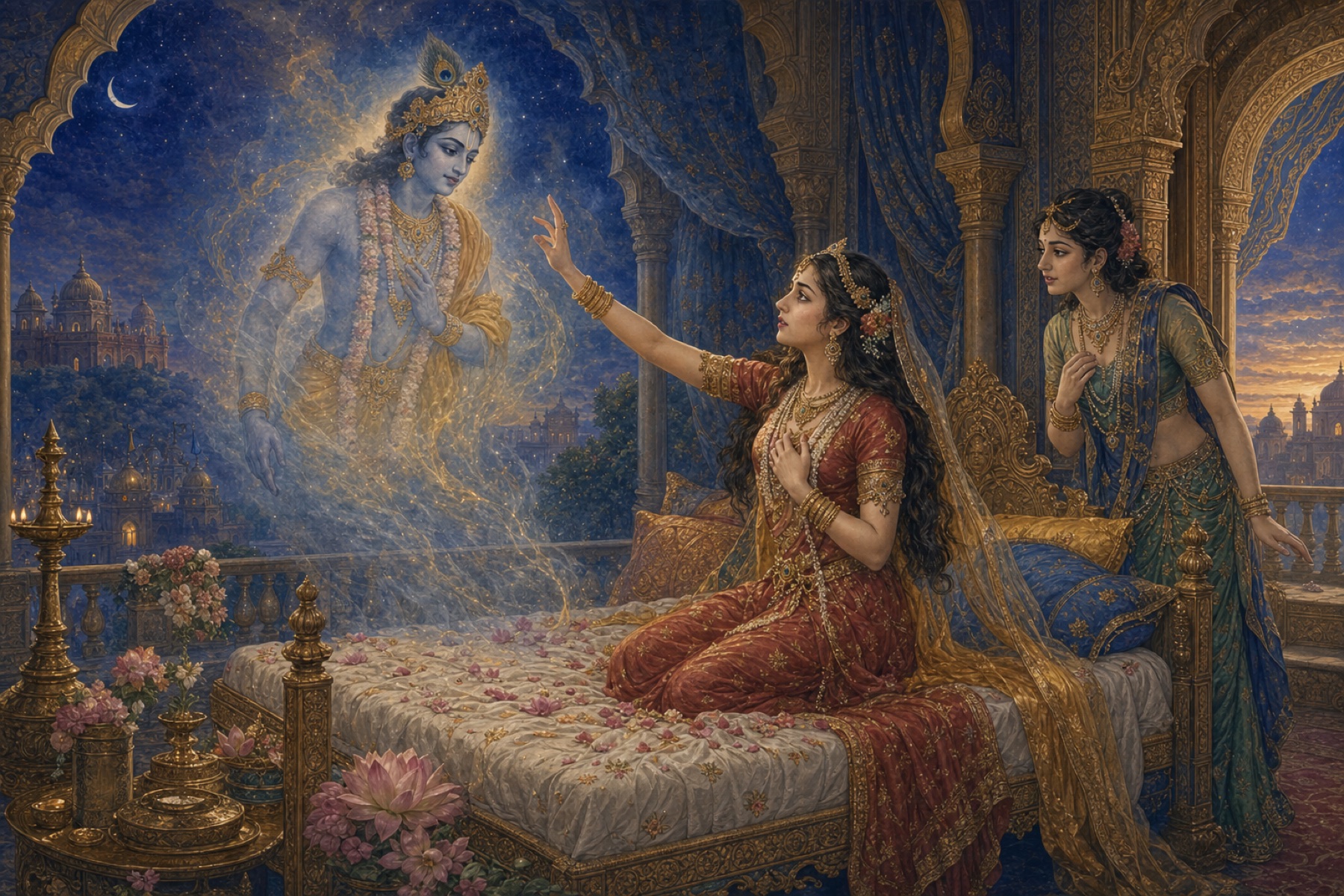
Princess Usha awakens after dreaming of Aniruddha while Citralekha listens nearby
Scene 01ŚB 10.62.10–16
01

ŚB 10.62.10–16

A face first seen in a dream

In Bāṇāsura’s protected city, his daughter Ūṣā dreams of a beautiful young man she has never met. He takes her heart, then disappears. She wakes calling for him, embarrassed to discover her companions have heard her.

This quiet beginning matters. The great battle of Chapter 63 does not begin with armies; it begins with a relationship hidden inside Bāṇa’s fortress.

Remember this frame

Ūṣā awakens with one unknown face fixed in her heart.
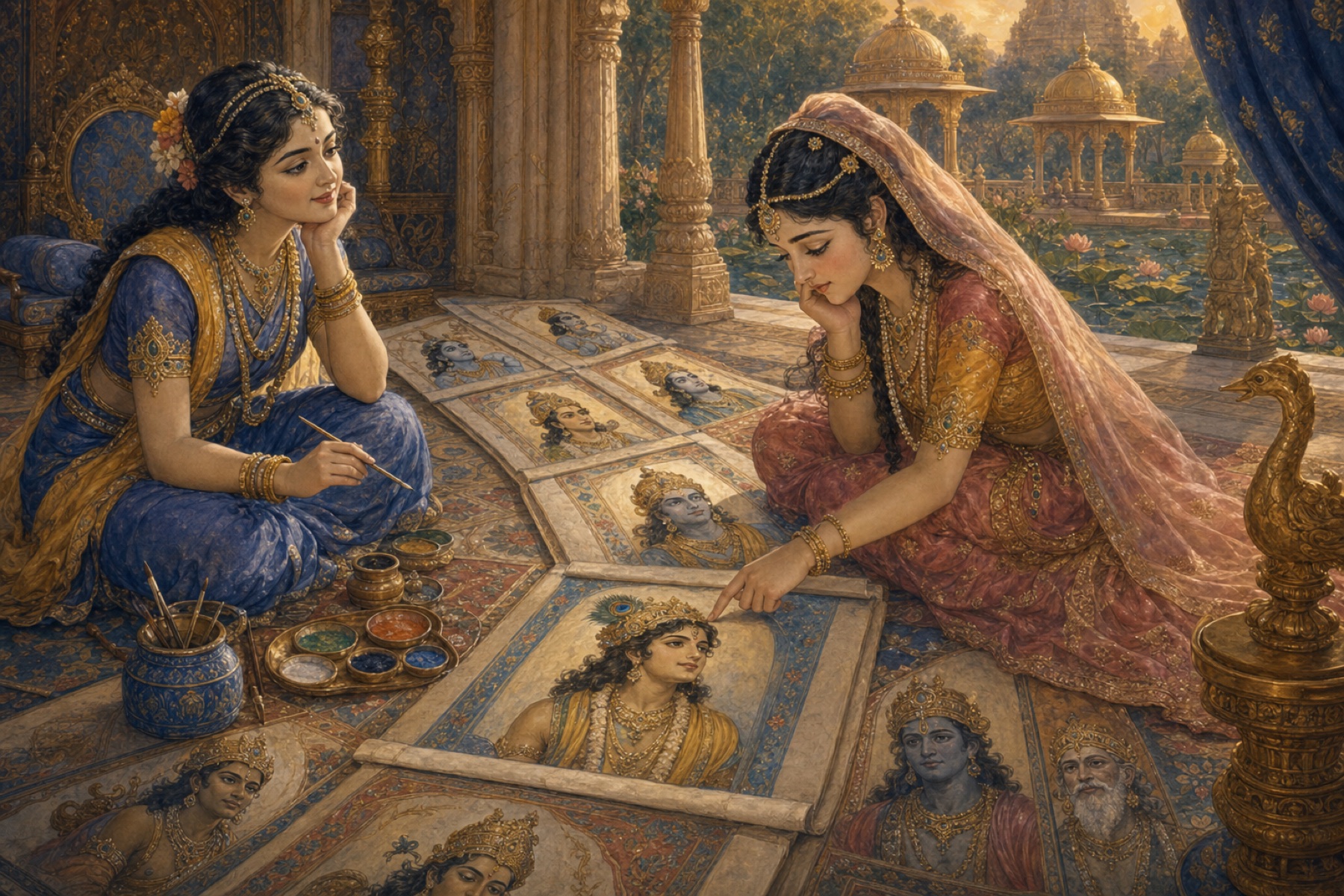
Citralekha shows painted portraits to Usha, who recognizes Aniruddha
Scene 02ŚB 10.62.17–19
02

ŚB 10.62.17–19

Citralekhā makes the unseen visible

Ūṣā’s friend Citralekhā is an artist and a mystic. She paints the leading gods, Gandharvas, demons and human dynasties. When she reaches the Yadus—Kṛṣṇa, Balarāma, Pradyumna and then Aniruddha—Ūṣā lowers her head and identifies the man from her dream.

Citralekhā has converted longing into a precise identity: Aniruddha, grandson of Kṛṣṇa. The first memory anchor is now complete—dream, search, recognition.

Remember this frame

A sequence of portraits ends with Ūṣā pointing to Aniruddha.

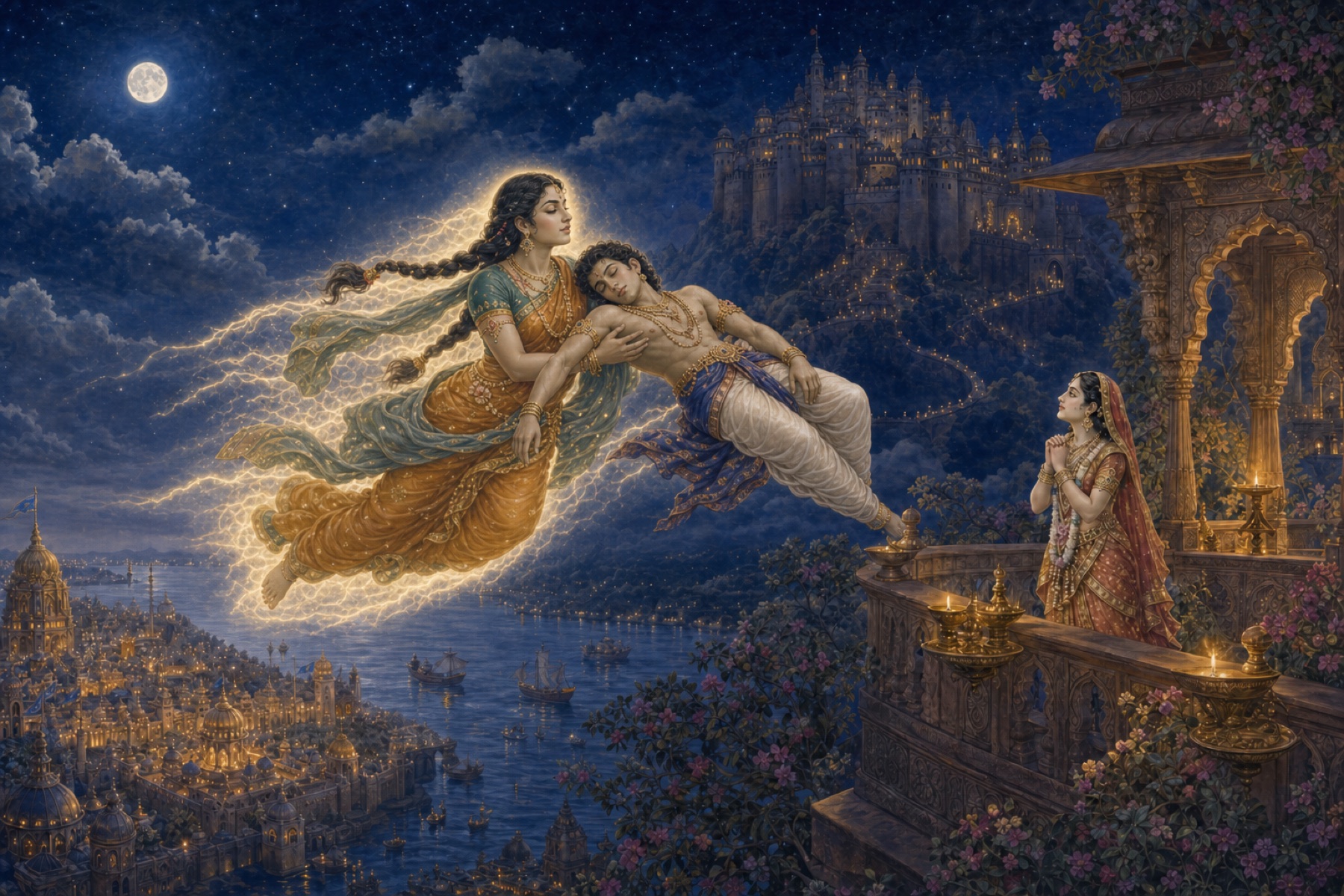
The yogin Citralekha carries the sleeping prince Aniruddha through the night sky toward Usha
Scene 03ŚB 10.62.20–24
03

ŚB 10.62.20–24

A yogin crosses the night

Using her mystic ability, Citralekhā travels by night to Dvārakā, finds Aniruddha sleeping and carries him to Śoṇitapura. Ūṣā receives him in her private quarters and serves him with affection.

For a time, Aniruddha is so absorbed in her company that he does not notice the passing days. Their hidden happiness is the still point before the story turns.

Remember this frame

Citralekhā carries the sleeping prince from the sea city to the mountain fortress.

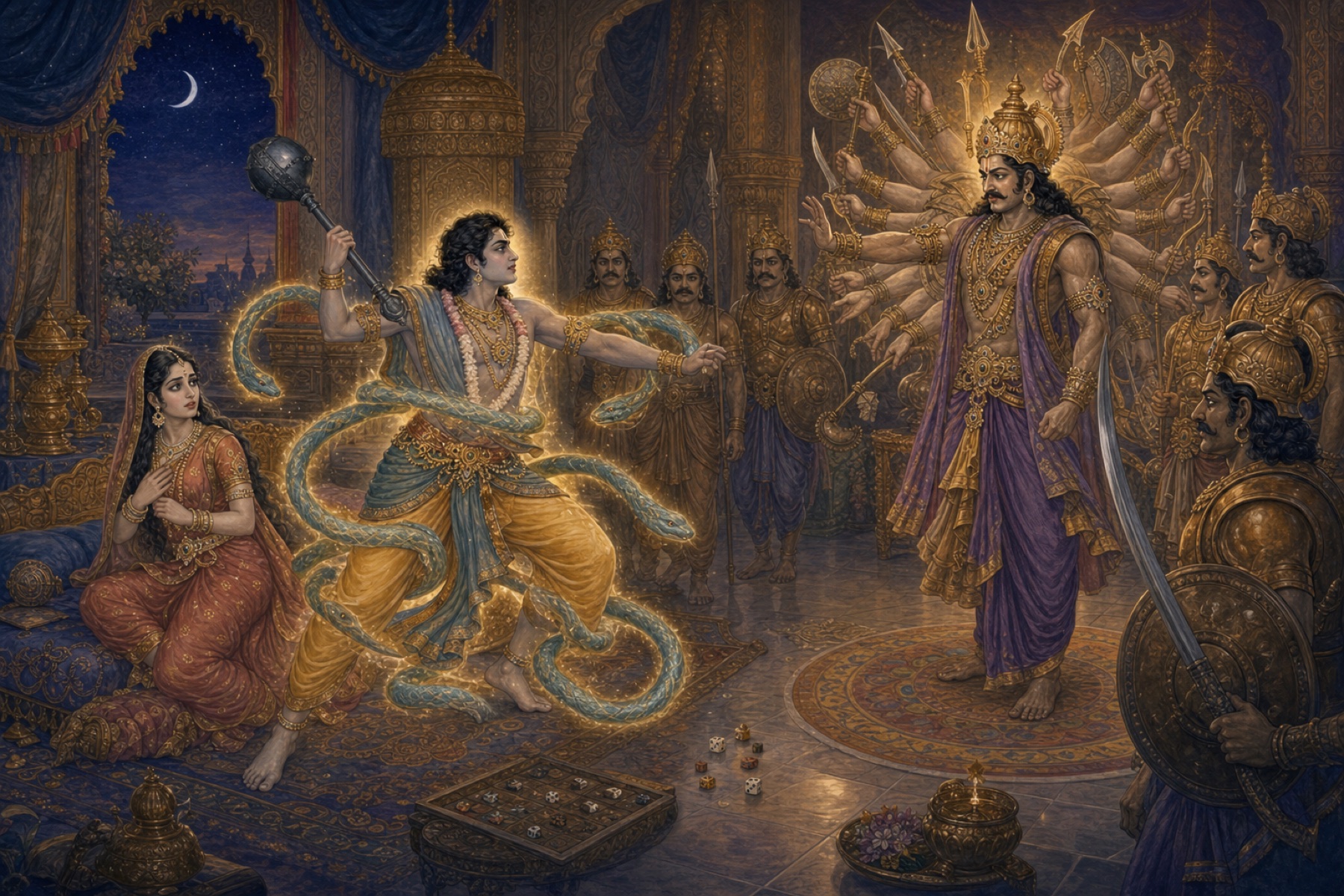
Aniruddha protects Usha with an iron club as Bana's guards enter and mystical serpent bonds surround him
Scene 04ŚB 10.62.25–33
04

ŚB 10.62.25–33

The secret is discovered

The guards recognize unmistakable signs that Ūṣā is meeting a man and report to Bāṇa. The king enters and sees Aniruddha—beautiful, fearless and seated with Ūṣā at a game of dice.

When guards rush him, Aniruddha seizes an iron club and drives them back. Bāṇa finally restrains him with the mystical nāga-pāśa, serpent bonds that ordinary strength cannot break.

Remember this frame

Dice scatter; the iron club rises; serpent bonds close.

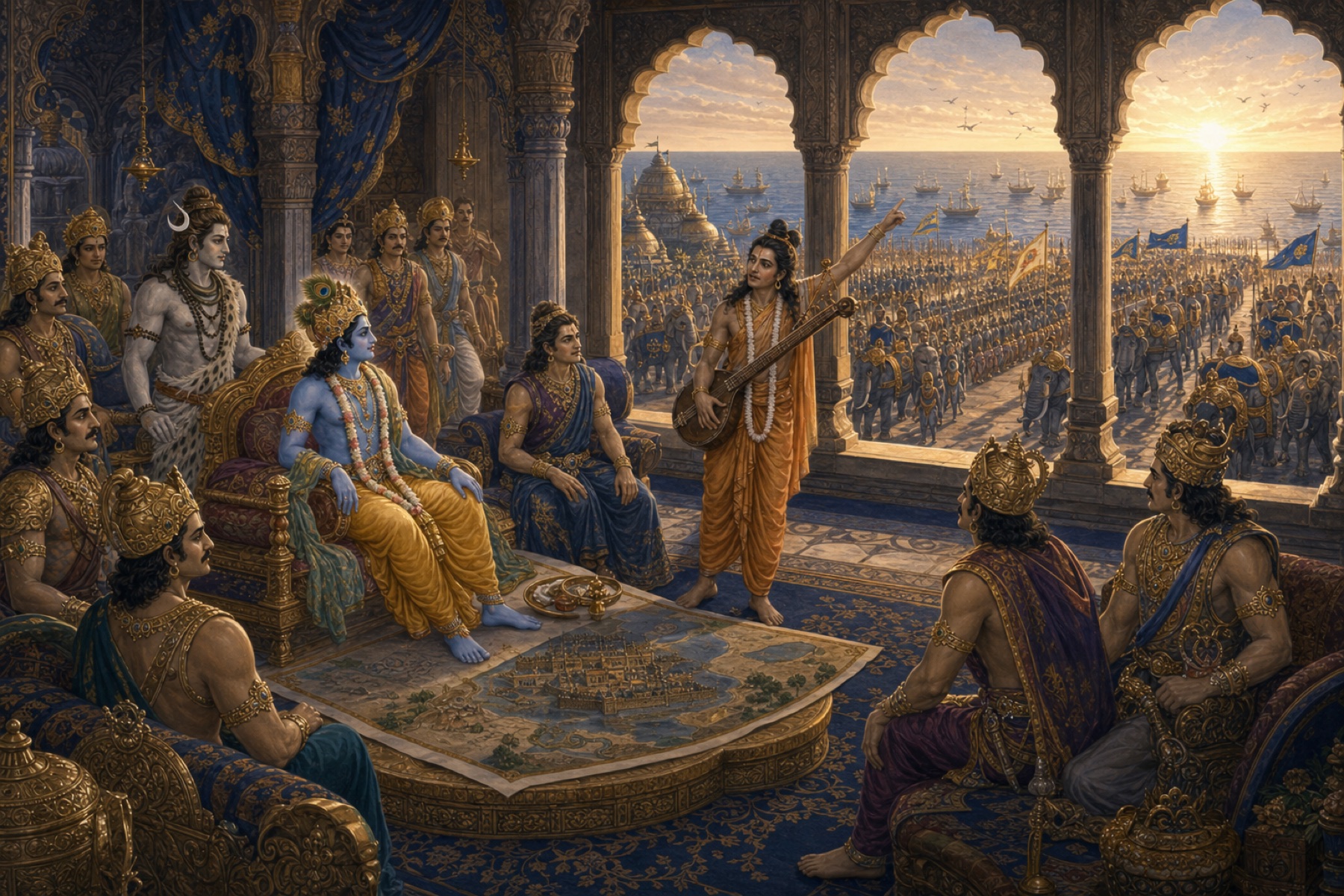
Narada informs Krishna and the Yadu chiefs while their army assembles outside Dvaraka
Scene 05ŚB 10.63.1–5
05

ŚB 10.63.1–5

Dvārakā learns where he is

Four rainy months pass while Aniruddha remains missing. Nārada reveals what happened. Kṛṣṇa, Balarāma, Pradyumna, Sātyaki, Sāmba and the Yadu leaders assemble twelve military divisions and advance on Śoṇitapura.

They surround the city and break its gardens, walls and gateways. The hidden romance has become a public crisis, and Bāṇa prepares to defend his pride.

Remember this frame

Nārada points to the captive city; twelve divisions move at dawn.

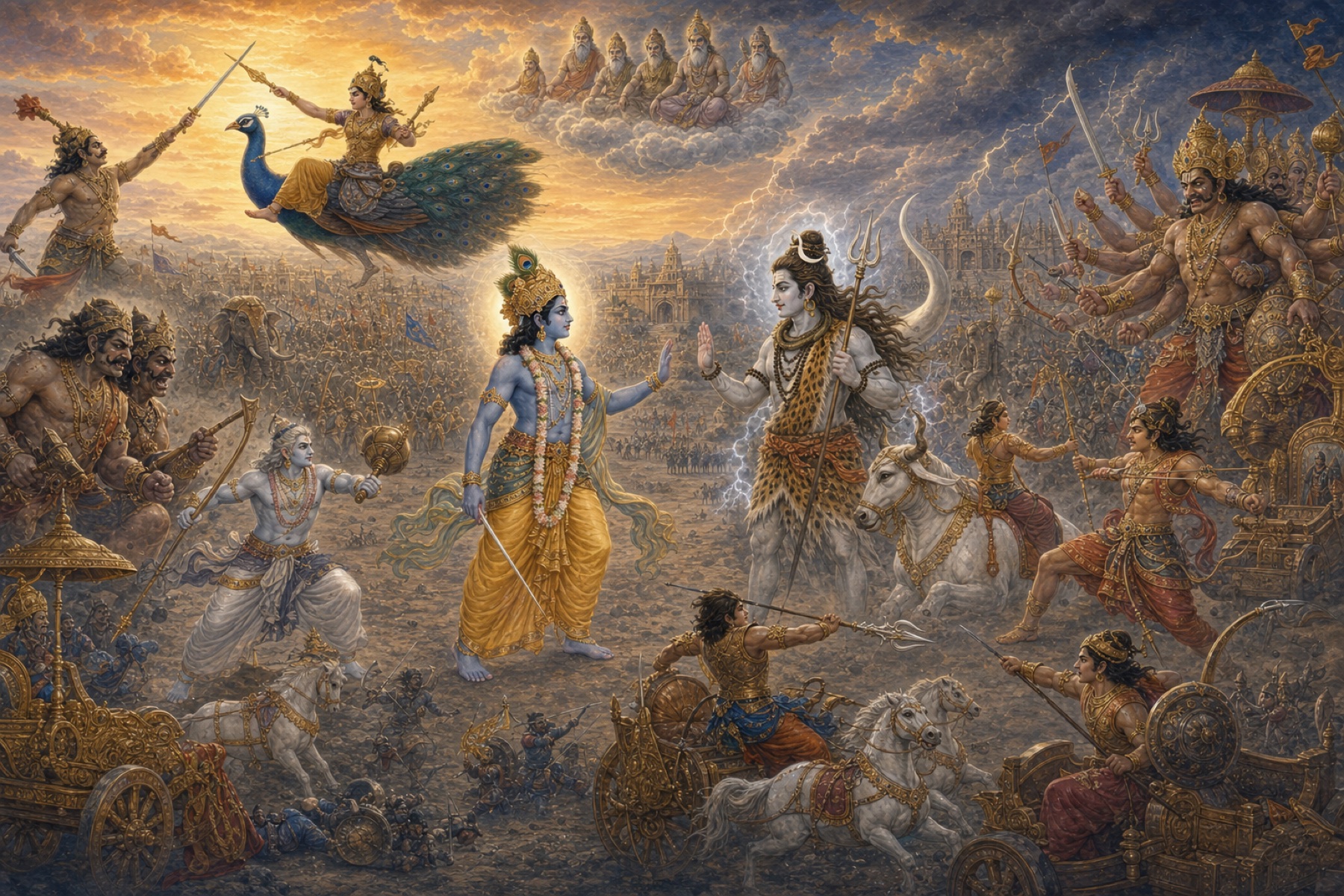
The principal warriors meet on the battlefield outside Sonitapura, with Krishna and Shiva at the center
Scene 06ŚB 10.63.6–9
06

ŚB 10.63.6–9

The opponents take their places

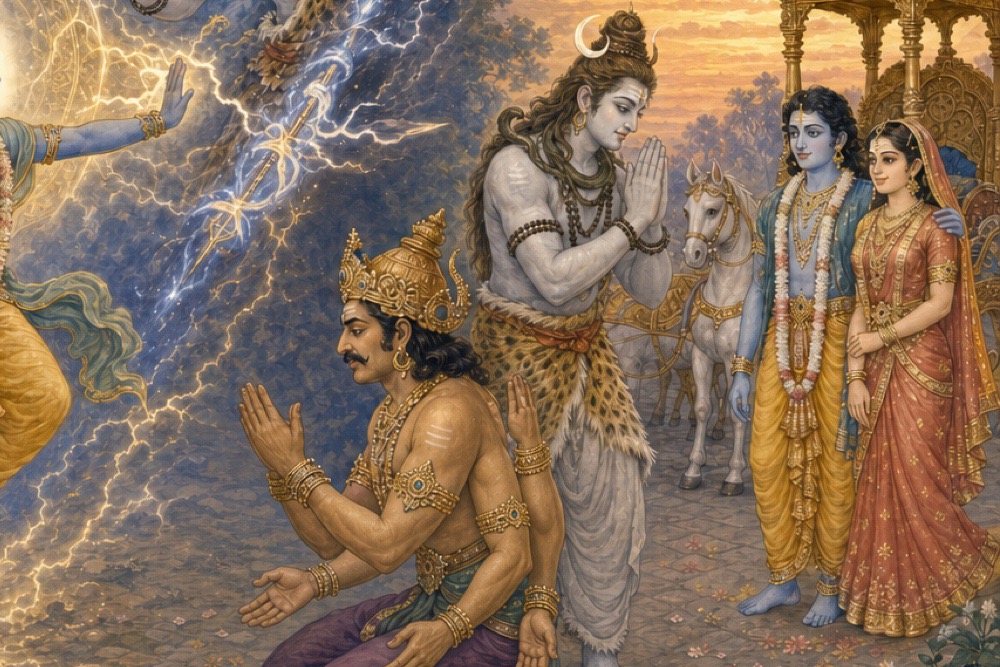
Lord Śiva, who had promised to protect his devotee Bāṇa, rides out with Kārtikeya and his followers. The principal contests form: Kṛṣṇa with Śiva; Pradyumna with Kārtikeya; Balarāma with Kumbhāṇḍa and Kūpakarṇa; Sāmba with Bāṇa’s son; Sātyaki with Bāṇa.

Brahmā, the sages and celestial beings gather overhead. The Bhāgavatam lets us see both loyalty and hierarchy: Śiva faithfully protects Bāṇa, while Kṛṣṇa remains the ultimate shelter of all.

Remember this frame

Five contests surround the central meeting of Kṛṣṇa and Śiva.

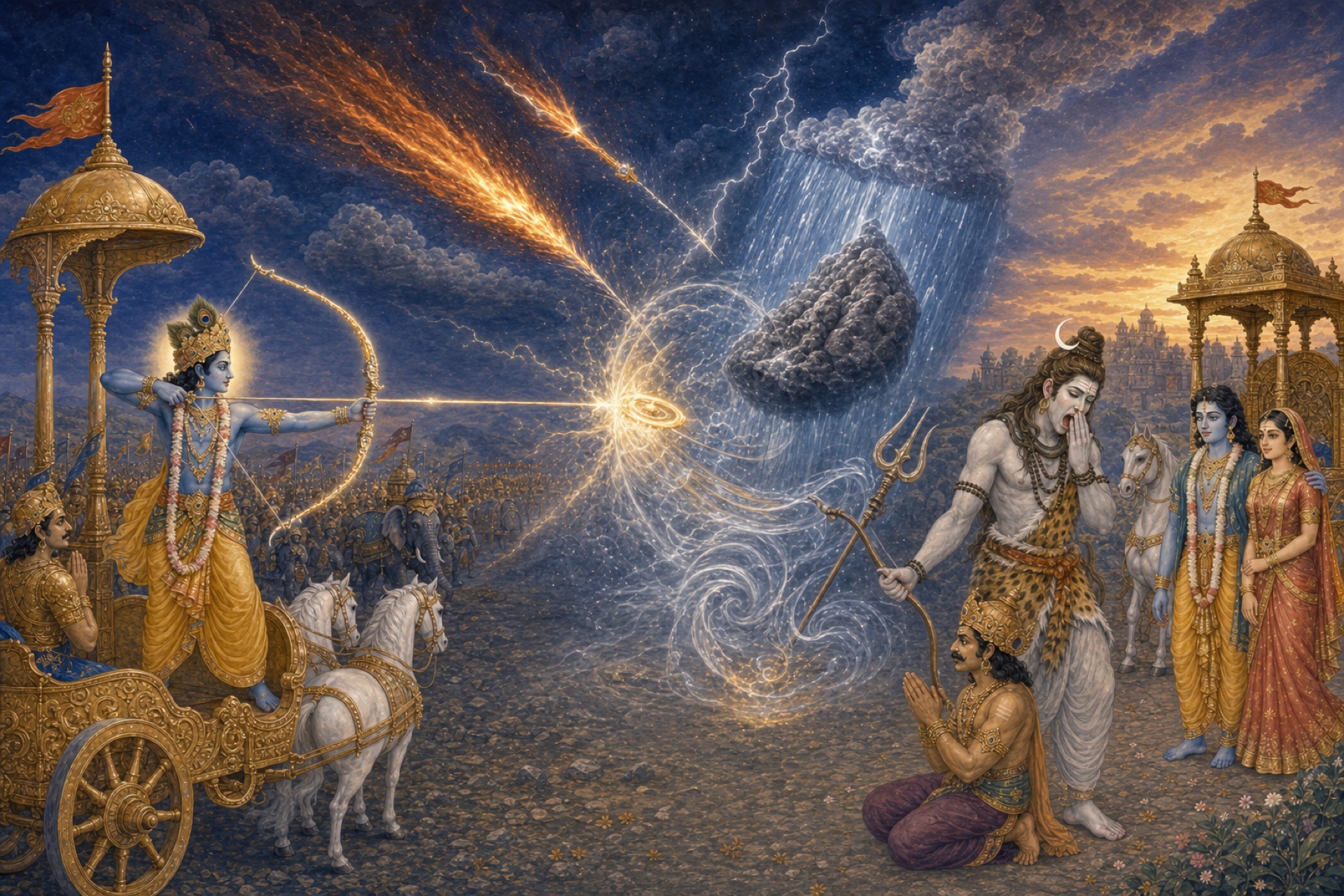
Krishna counters Shiva's celestial weapons with rain, mountain, wind and luminous divine forces
Scene 07ŚB 10.63.10–14
07

ŚB 10.63.10–14

Every weapon meets its answer

Śiva releases celestial weapons; Kṛṣṇa answers each one precisely. A brahmāstra meets a brahmāstra, wind meets a mountain weapon, fire meets rain, and the pāśupata weapon is checked by the nārāyaṇa weapon.

Kṛṣṇa then releases a yawning weapon. Overcome by repeated yawns, Śiva lowers his attack. The scene is not ridicule; it is a theological turning point rendered through effortless mastery rather than rage.

Remember this frame

Fire becomes rain; wind meets mountain; the bow lowers in a yawn.

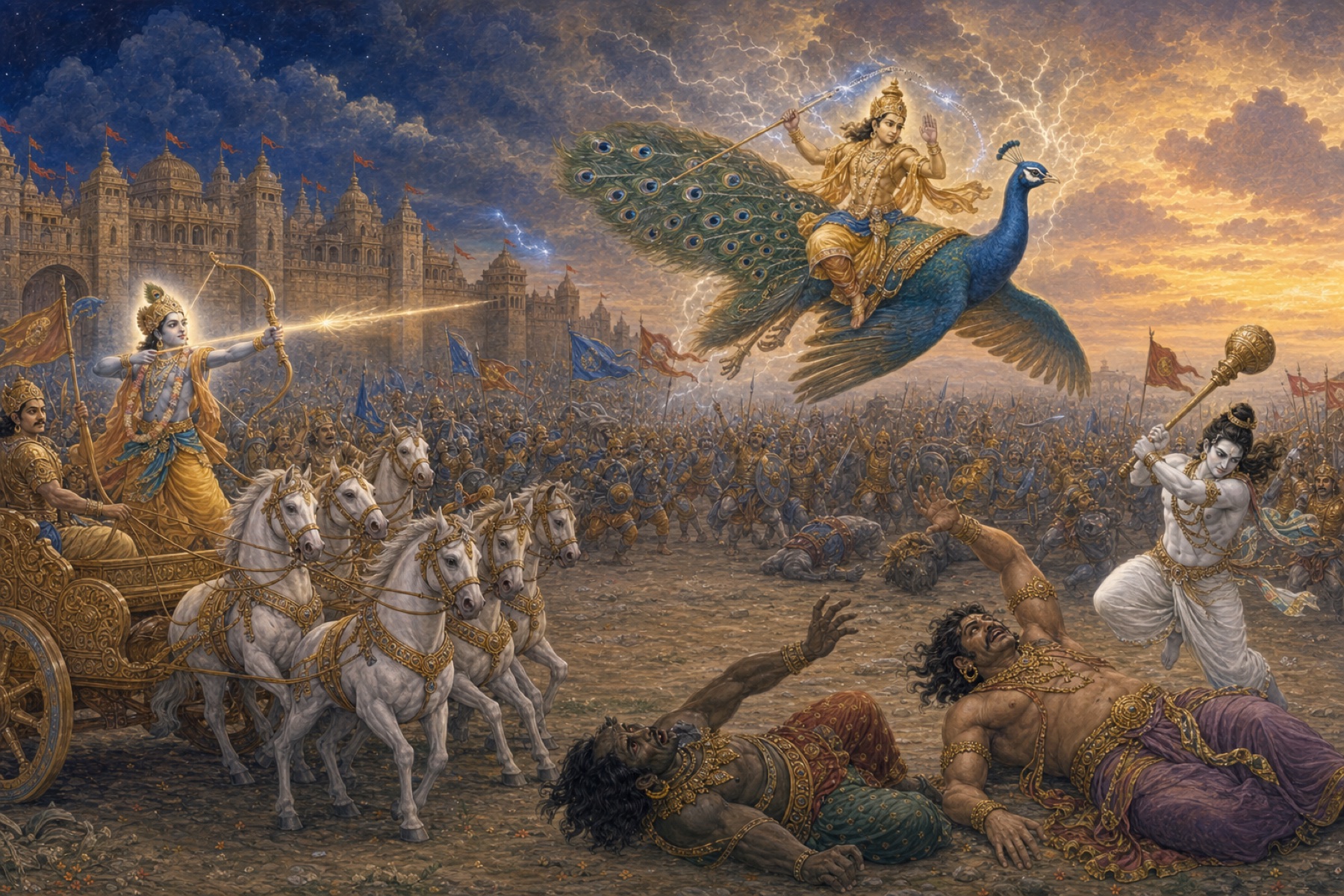
Pradyumna drives Kartikeya away on his peacock while Balarama defeats Bana's giant allies
Scene 08ŚB 10.63.15–18
08

ŚB 10.63.15–18

The supporting battles resolve

Pradyumna’s arrows wound Kārtikeya, who withdraws on his peacock. Balarāma strikes down Kumbhāṇḍa and Kūpakarṇa. Seeing their leaders fall, Bāṇa’s soldiers scatter.

These are not decorative side episodes. They remove each layer of resistance around Bāṇa until the proud king must face Kṛṣṇa directly.

Remember this frame

The peacock rises; Balarāma stands; the surrounding army breaks.

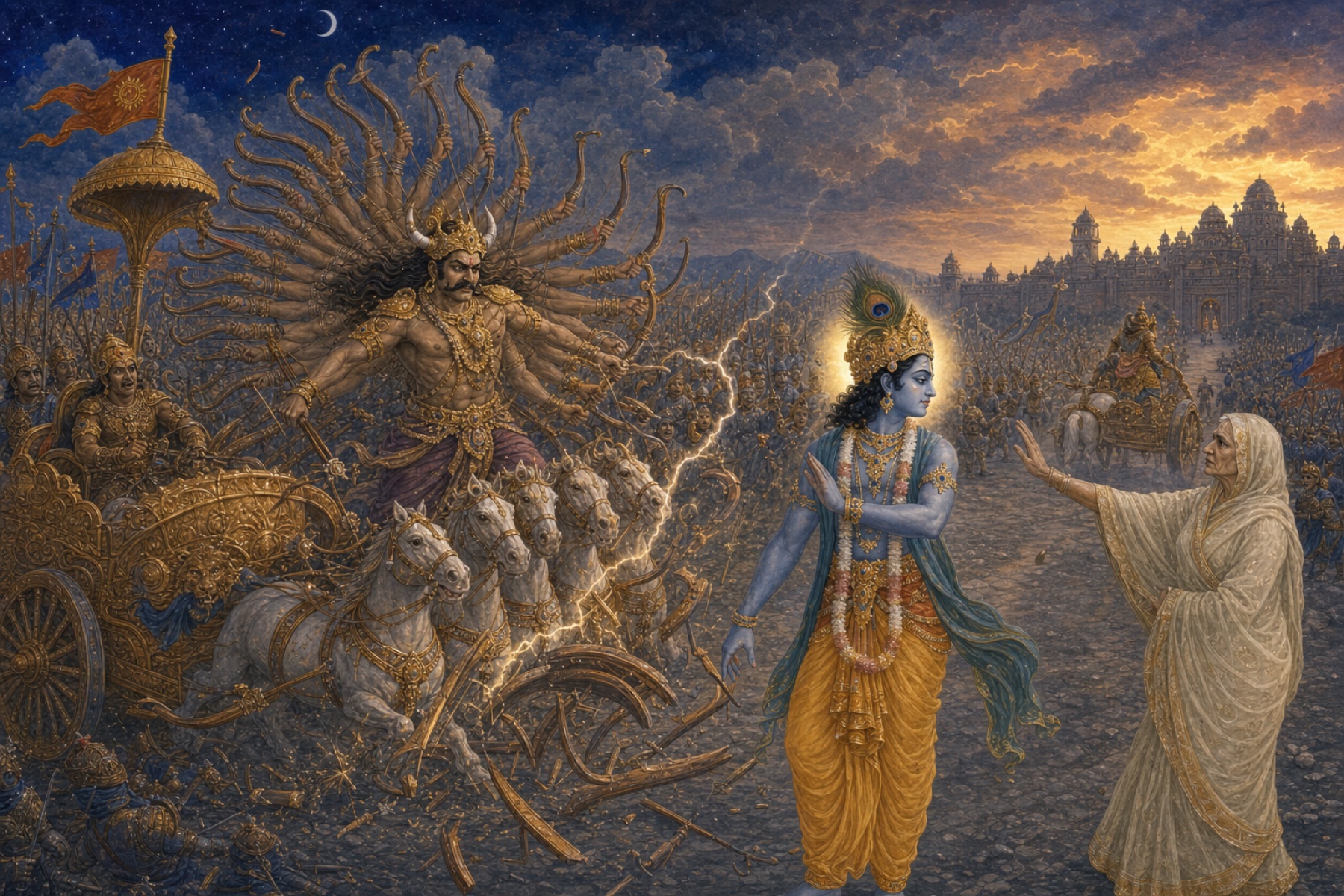
Many-armed Bana attacks with numerous bows while Krishna shatters them and respectfully turns from Bana's veiled mother
Scene 09ŚB 10.63.19–21
09

ŚB 10.63.19–21

Five hundred bows are not enough

Bāṇa simultaneously bends five hundred bows and sends two arrows from each. Kṛṣṇa cuts every bow, disables the chariot and strikes the horses and driver. Magnitude cannot compensate for pride.

Bāṇa’s mother, Koṭarā, intervenes. Kṛṣṇa respectfully turns his face, allowing Bāṇa to escape into the city. Even amid battle, restraint governs the Lord’s conduct.

Remember this frame

A fan of bows breaks; Kṛṣṇa turns aside; Bāṇa retreats.

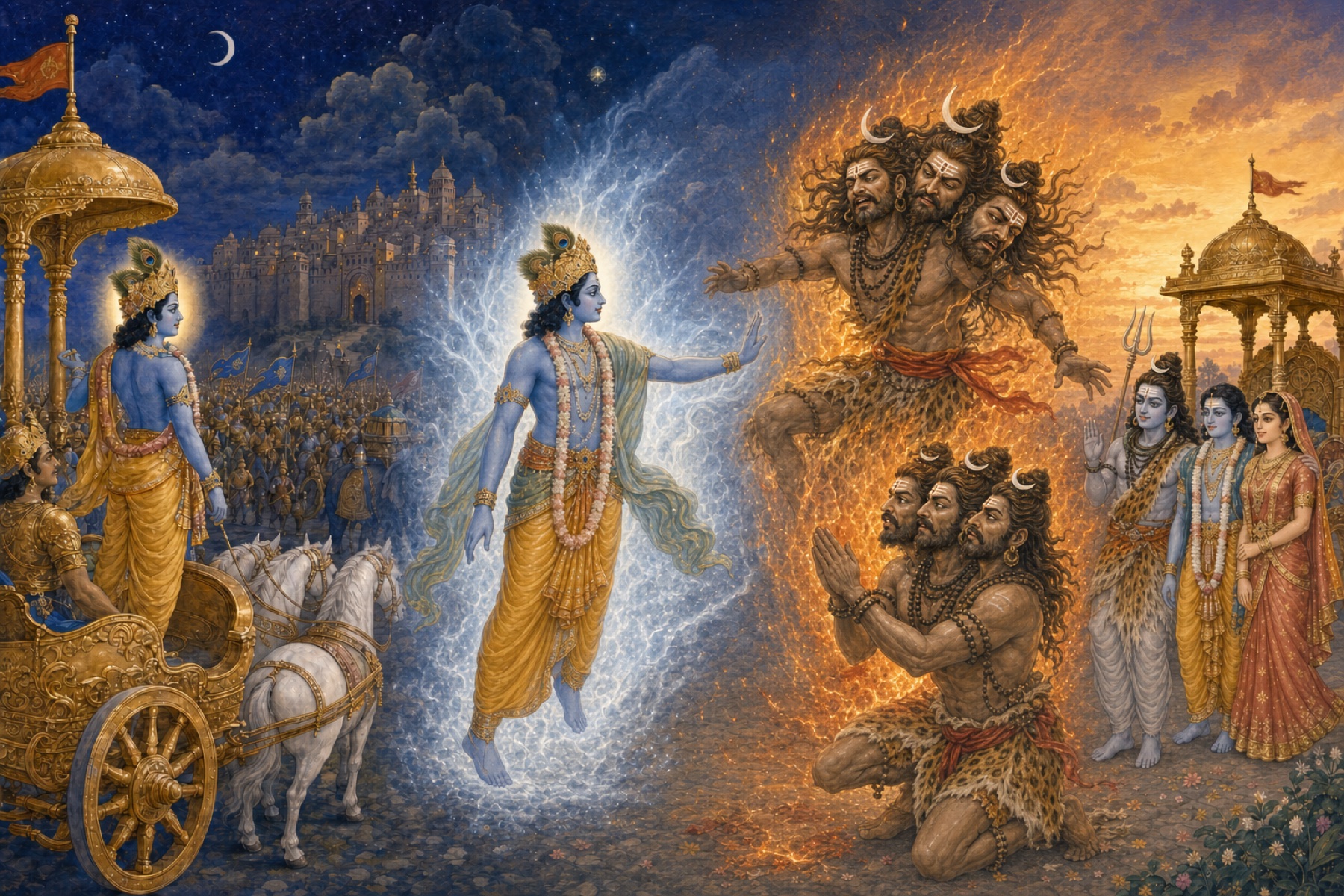
The fiery three-headed Shiva-jvara is overcome by the cooling Narayana-jvara and surrenders before Krishna
Scene 10ŚB 10.63.22–30
10

ŚB 10.63.22–30

Heat meets the cold of dissolution

A terrible personified fever sent by Śiva approaches: Śiva-jvara, with three heads and three feet, burning in every direction. Kṛṣṇa answers with Nārāyaṇa-jvara, an unbearable cold. The fever of heat is overwhelmed and seeks refuge in Kṛṣṇa.

After offering prayers, Śiva-jvara receives fearlessness. Kṛṣṇa adds a smaller benediction within the larger story: one who remembers this conversation need not fear the fever.

Remember this frame

Three-headed heat meets cooling light, then folds its palms.

A humbled Bana kneels before compassionate Krishna while Shiva offers prayers
Scene 11ŚB 10.63.31–49
11

ŚB 10.63.31–49

Pride is cut away; the person is spared

Bāṇa returns with his thousand arms and weapons. Kṛṣṇa’s Sudarśana disc cuts away the excess until four arms remain. When Śiva prays for his devotee, Kṛṣṇa explains that he will not kill Bāṇa, a descendant of Prahlāda and Bali.

The aim was not annihilation. Bāṇa’s burdening army and false pride are removed; his life, devotion to Śiva and protected status remain. Victory culminates in correction and mercy.

Remember this frame

The disc removes excess; Śiva prays; Kṛṣṇa raises a hand of protection.

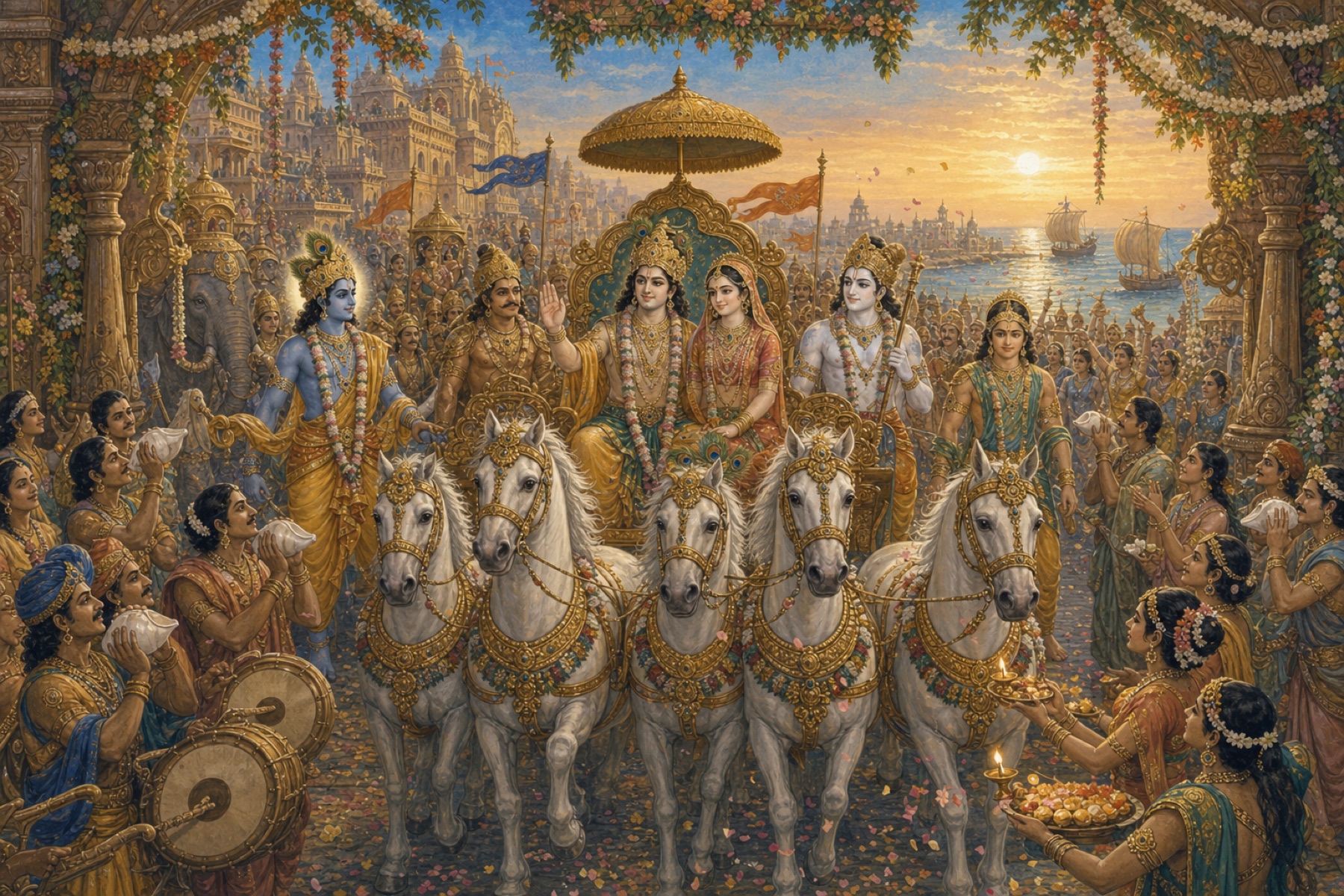
Aniruddha and Usha return with Krishna's joyful procession into Dvaraka
Scene 12ŚB 10.63.50–53
12

ŚB 10.63.50–53

The victory returns home

Bāṇa brings Ūṣā and Aniruddha forward. With Śiva’s approval, Kṛṣṇa places the couple at the head of the procession and returns to Dvārakā, where flags, gateways, conches and drums receive them.

Only now does the final verse give its promise, naming Kṛṣṇa’s victory as the object of remembrance at dawn. This guide traces the whole narrative movement so that memory can be informed and concrete: concern becoming action, power meeting its limit, fever finding refuge, pride becoming humility, and a family returning in peace.

Remember this frame

Ūṣā and Aniruddha lead the flower-strewn procession home.

Carry the victory forward

At daybreak, walk the twelve scenes once more.

Begin with Ūṣā’s dream. Name each turn in sequence. End with Kṛṣṇa’s mercy to Bāṇa and the couple’s return to Dvārakā. Then read Chapters 62–63 in the complete BBT edition so the original translations and purports—not this abbreviated guide—shape the remembrance.